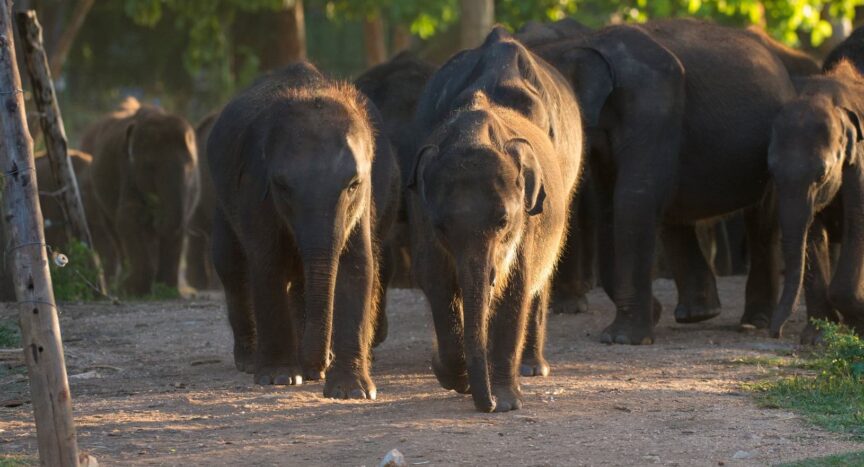
At the Elephant Transit Home in Udawalawe, feeding time looks a little like chaos and a lot like joy. Every three hours, a group of orphaned calves comes trotting out of the forest edge, ears flapping, trunks reaching, jostling each other for a place at the milk line. Keepers move calmly among them, pouring warm milk formula through tubes and funnels while the calves drink with the kind of urgency only a baby animal can manage. Visitors watch from a respectful distance, behind a rustic rail, in complete silence broken only by trumpeting and the occasional splash.
It is, by any measure, an ordinary afternoon at the Home. It is also one of the most quietly remarkable conservation stories in Sri Lanka – and one that Dilmah has been part of for close to two decades.
Today, Dilmah sponsors the care of 14 rescued baby elephants at the Elephant Transit Home, as part of Dilmah Conservation’s commitment to biodiversity protection. Full, current details of the elephants under our care can always be found on the Dilmah Conservation website (https://www.dilmahconservation.org).
Why the Elephant?
Sri Lanka’s relationship with the elephant is older than its recorded history. The animal appears in temple carvings and royal chronicles, leads the Kandy Esala Perahera each year bearing the sacred relic of the Tooth of the Buddha, and lives in local folklore as a symbol of memory, patience and quiet strength. To harm an elephant, in the old telling, was to invite consequence; to protect one was to earn merit. That reverence has not disappeared – it has simply had to coexist with a modern, fast-developing island where land is scarcer than it has ever been.
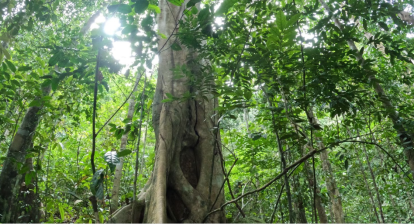
But the elephant’s importance is not only symbolic. Elephants are what ecologists call a keystone species – their daily lives quite literally build the ecosystems around them. A single elephant can disperse the seeds of dozens of plant species across many kilometres in a single day, regenerating forest as it walks. Their trails become waterways in the dry season. The clearings they create in dense undergrowth become grazing ground for deer, sambar and other herbivores, which in turn sustain the leopards above them in the food chain. Remove the elephant, and Sri Lanka’s dry-zone forests and grasslands – the very landscapes that shape the island’s rainfall, its rivers, and its tea-growing highlands beyond them – begin to unravel in ways felt long after the animal itself is gone.
And yet Sri Lanka’s elephants are under serious pressure. As agricultural land and human settlements have expanded into traditional elephant corridors, human-elephant conflict has become one of the country’s most painful conservation challenges, claiming both human and elephant lives every year. Calves are frequently the first casualties – orphaned when their mothers are killed or fatally injured, too young to survive alone in the wild.
A Cause that Found Us, not the Other Way Around
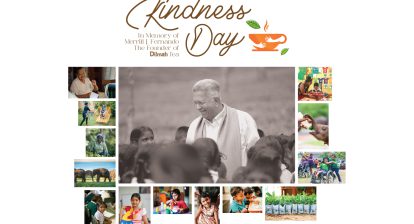
Dilmah’s purpose has never been separate from its business. Since Merrill J. Fernando founded the company on the belief that “business is a matter of human service,” Dilmah has treated the land, the communities, and the biodiversity of Sri Lanka as things to be protected, not simply used. Tea itself is grown in landscapes elephants have shaped for millennia. Supporting their survival was never a marketing decision – it was an extension of the same philosophy that built the MJF Charitable Foundation and Dilmah Conservation: that a business rooted in a place carries a responsibility to that place, in full.
That is why elephant conservation sits inside our purpose and kindness pillar alongside our work with children, tea communities, and the wider natural world – different expressions of the same idea, that kindness is something a business can practice deliberately, not just profess.
What that Commitment has Looked Like, in Practice
Feeding and nurturing: Orphaned calves arrive at the Elephant Transit Home frightened, malnourished, and sometimes injured. Dilmah’s significant sponsorship helps fund their care from that first day – specially formulated milk, veterinary attention, and the patient, minimal-contact approach that keeps them wild at heart even as they are nursed back to health. The Home’s philosophy is deliberate: keepers feed and monitor the calves, but do not tame them, because every calf raised here is meant to return to the forest, not to a life among people.
Rewilding: The entire purpose of the Elephant Transit Home is release, not retention – and it has become the most successful elephant reintroduction programme of its kind anywhere in the world, with well over 200 calves cared for and returned to the wild since 1995. Dilmah-sponsored elephants have gone through this journey themselves. Ted, one of the first calves Dilmah sponsored, was among the very first group selected for the Home’s soft-release programme in 2019 – a gradual reintroduction designed to ease the transition back to forest life – and was released into Udawalawe National Park in 2020, monitored afterwards to confirm he had settled well into a wild herd.
The elephant walk at the Transit Home: For visitors – including guests of Dilmah’s Resplendent Ceylon resorts, for whom a visit to the Home can be arranged as part of their stay – feeding time is the closest most people will ever come to these animals, and it is designed to stay that way. There is no touching, no riding, no posing for photographs. Visitors simply watch, from a distance, as calves of all ages and personalities come bounding in for their milk. It is an experience built around respect rather than spectacle, and it has quietly taught thousands of visitors what ethical wildlife tourism can look like.
Infrastructure upgrades: Good intentions need good facilities behind them. Dilmah Conservation has funded renovations at the Elephant Transit Home, established and equipped a dedicated Information Centre so visitors can learn about the threats elephants face, and installed solar water heating and water filtration systems with UV sterilisation to make the Home’s daily operations more sustainable and less costly to run.
Continuous stewardship and advocacy: Sponsorship, for Dilmah, has never been a one-time gesture. Our support of the Elephant Transit Home has continued year after year, alongside broader work with the Department of Wildlife Conservation and the Centre for Conservation and Research – including radio-collaring studies that help scientists understand how released elephants move, settle and thrive once they return to the wild. It is research that quietly strengthens the case for protecting elephant habitat across the island, long after any individual calf has grown up and moved on.
Fourteen Calves, One Promise
Every one of the 14 calves currently in our care arrived at the Elephant Transit Home because something went wrong – a mother lost, a herd scattered, an encounter with humans that no calf should have to survive alone. What happens next is entirely within our power to shape. A warm bottle of milk. A safe place to grow. A slow, careful walk back into the wild, monitored and protected until they no longer need us at all.
That, in the end, is what kindness looks like when it is put into practice rather than simply spoken about – patient, unglamorous, and consistent, calf after calf, year after year. To learn more about the elephants currently under Dilmah’s care, or to find out how you can support the Elephant Transit Home, visit [dilmahconservation.org] (https://www.dilmahconservation.org).